
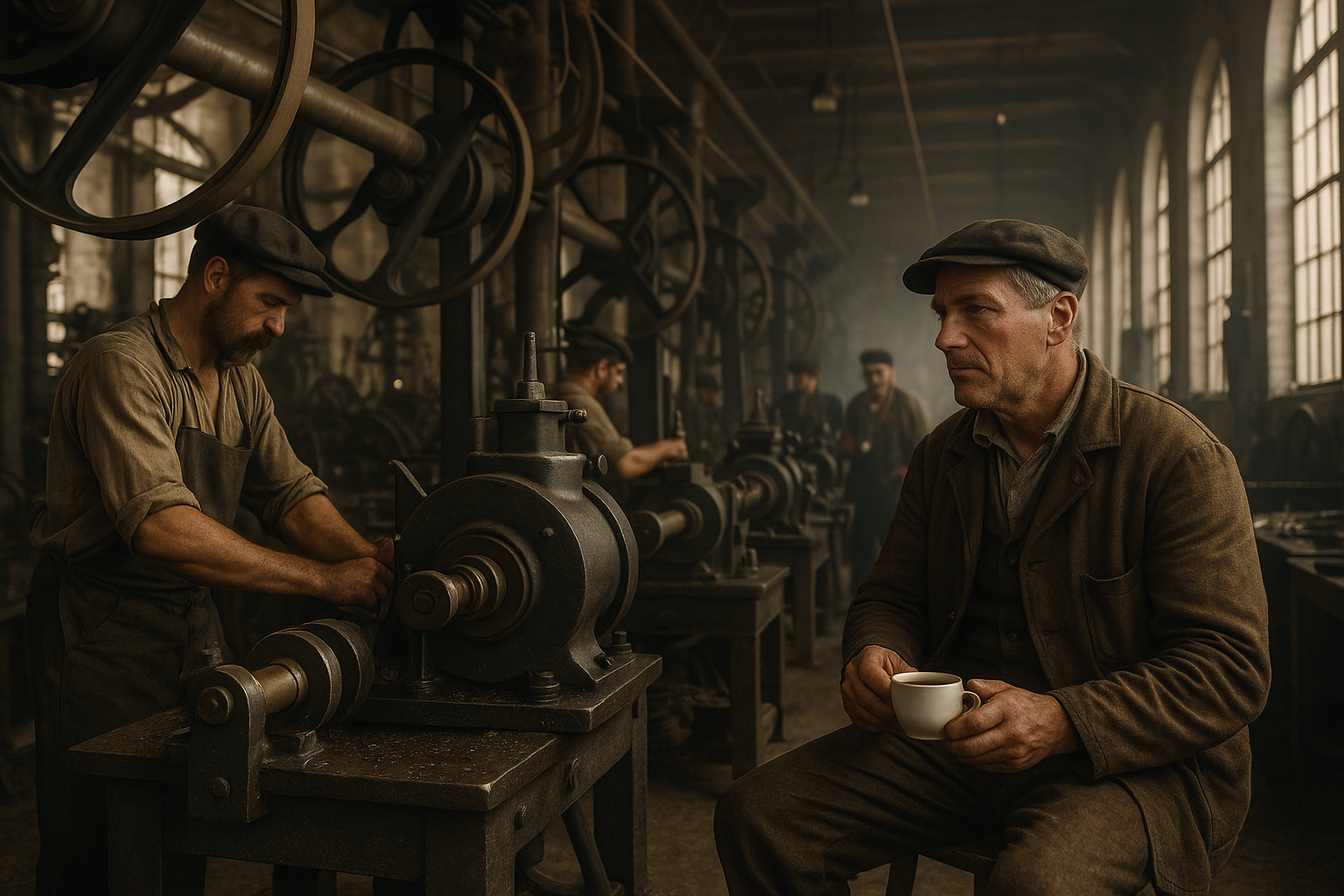
The Industrial Revolution marked a turning point in human history. As factories replaced fields and machines replaced manual labor, societies underwent profound changes.
While steam engines and textile mills often dominate the conversation, one humble element played a powerful supporting role in this transformation: coffee.
It was the drink that fueled workers and thinkers alike. It sharpened minds, extended working hours, and reshaped culture in both subtle and dramatic ways.
This is the story of how coffee helped energize the engines of industry and supported the rise of the modern world.
A New Kind of Energy for a New Era
Before the Industrial Revolution, alcohol was often the beverage of choice among laborers. Beer and wine were commonly consumed throughout the day, even during work hours.
This began to change with the increasing availability of coffee.
Unlike alcohol, coffee stimulated rather than sedated. It helped workers stay awake, focused, and productive.
Factory owners took note. Encouraging the consumption of coffee became a smart strategy for boosting efficiency.
In many ways, coffee became the unofficial fuel of industrial labor.
The Rise of the Working Class Café
As cities grew and working-class neighborhoods expanded, so did the number of coffeehouses and cafés.
These establishments provided not just caffeine, but also a much-needed social and mental escape from the harsh realities of factory life.
Workers would gather before or after their shifts to read newspapers, discuss politics, and share ideas. These modest venues became hotbeds of grassroots social consciousness.
Coffeehouses were often more than places to drink. They became incubators for change, offering the working class a rare space for intellectual engagement.
Coffee and Time Discipline
One of the biggest cultural shifts of the Industrial Revolution was the concept of time.
Pre-industrial societies operated more fluidly, guided by nature and necessity. But the factory system demanded strict schedules.
Coffee played an important role in this transition.
Its energizing properties made it easier for people to adapt to long, rigid workdays. Coffee breaks became institutionalized in factories, helping to keep morale and productivity high.
The coffee break was not just a luxury—it became a necessity.
Coffee and the Expansion of Night Work
As artificial lighting advanced, factories began operating around the clock. This presented a problem: how could workers stay alert during night shifts?
Once again, coffee came to the rescue.
Its ability to combat fatigue made it the beverage of choice for late-night laborers. It helped sustain alertness during monotonous or physically demanding tasks.
In many industrial cities, the smell of coffee was as common in the dead of night as it was in the early morning.
Caffeine quietly revolutionized the workforce, one cup at a time.
Coffee’s Role in Innovation and Creativity
While laborers drank coffee for energy, inventors and entrepreneurs consumed it for inspiration.
The Industrial Revolution wasn’t just powered by machines—it was driven by bold new ideas. Many of these came from the minds of thinkers who relied on coffee to keep their creativity flowing.
From workshop basements to university labs, coffee was present wherever innovation took root.
It’s no surprise that coffeehouses became informal offices for inventors, engineers, and investors. Many revolutionary projects began over a pot of coffee and a stack of notes.
The Coffee Trade and Industrial Growth
The Industrial Revolution didn’t just transform coffee consumption—it also changed the way coffee was produced and traded.
With the rise of steamships and railways, coffee could be transported faster and farther than ever before. This helped create a global coffee trade that supported industrial economies.
Coffee plantations in colonies were expanded to meet the growing demand. Unfortunately, this expansion often relied on exploitative labor systems.
While coffee helped fuel industrial growth in the West, its production raised complex ethical issues that are still discussed today.
Coffee and the Rise of the Middle Class
The Industrial Revolution also saw the emergence of a middle class that valued self-improvement, education, and culture.
Coffee fit perfectly into this new identity.
Unlike alcohol, which was associated with vice and idleness, coffee was seen as virtuous. It encouraged alertness, reading, and conversation.
Middle-class families often had dedicated coffee services, and drinking coffee became part of a civilized, aspirational lifestyle.
Cafés catering to the middle class often featured books, music, and lectures, blending leisure with intellectual refinement.
The Birth of the Modern Coffee Industry
The growing demand for coffee during the Industrial Revolution laid the foundation for today’s modern coffee industry.
Technological advancements such as vacuum-sealed packaging, espresso machines, and instant coffee all emerged from industrial principles applied to the coffee trade.
These innovations made coffee more accessible and standardized, helping to transform it from a luxury to a daily necessity.
The factories that once made steam engines began producing coffee mills, brewers, and filters.
Coffee had become both a product of the Industrial Revolution and a contributor to its expansion.
Coffee and Worker Solidarity
Interestingly, coffee also played a role in early labor movements.
During breaks in harsh factory environments, workers would gather over coffee to share grievances and plan collective actions.
The act of drinking coffee together became a symbol of unity and mutual support.
In some cities, coffeehouses became unofficial headquarters for union organizing. They offered a safer space than the factory floor to discuss wages, hours, and workers’ rights.
In this way, coffee not only supported the system—it also fueled resistance to it.
Coffee as Cultural Equalizer
In the midst of massive economic shifts and social stratification, coffee offered a rare common ground.
It was consumed by the rich and poor alike—by factory workers, businessmen, and artists.
This cultural overlap made coffee a democratizing force. Regardless of status, people could share a cup and exchange thoughts.
The Industrial Revolution divided society in many ways, but coffee remained a shared ritual that subtly bridged those divides.
A Quiet Revolution in a Cup
Looking back, it’s easy to see how coffee quietly revolutionized daily life during the Industrial era.
It helped adapt human energy to the demands of machines. It supported longer working hours and encouraged intellectual growth. It even helped organize social movements and foster new cultural norms.
While it didn’t receive headlines like railroads or cotton mills, coffee was just as influential in shaping the modern world.
It was there in every darkened factory, every buzzing office, and every crowded café.
Echoes in the Modern Workplace
Many of the coffee-related habits we take for granted today have roots in the Industrial Revolution.
The morning coffee ritual, the mid-afternoon pick-me-up, the coffee break room—they all evolved from this era.
Modern corporate culture, with its meetings and brainstorm sessions fueled by espresso shots and cappuccinos, continues this legacy.
Even remote workers today often begin their day with a home-brewed cup, channeling the same energy and focus needed during the dawn of industry.
Final Reflection: The Unsung Engine of Progress
The Industrial Revolution changed the world in irreversible ways. While machines and technology took center stage, coffee worked in the background—quiet, consistent, and powerful.
It woke up the working class.
It stimulated innovation.
It connected people across classes and continents.
And it continues to be a symbol of energy, focus, and productivity in our modern lives.
So next time you sip your morning brew, remember: that little cup holds centuries of human progress and the legacy of a revolution.

Marcelo Oliveira is a passionate coffee enthusiast and writer who explores every angle of the world’s favorite brew—from its rich history to modern brewing techniques. With a deep appreciation for both tradition and innovation, Marcelo brings clear, engaging insights to help readers enjoy coffee on a whole new level.