
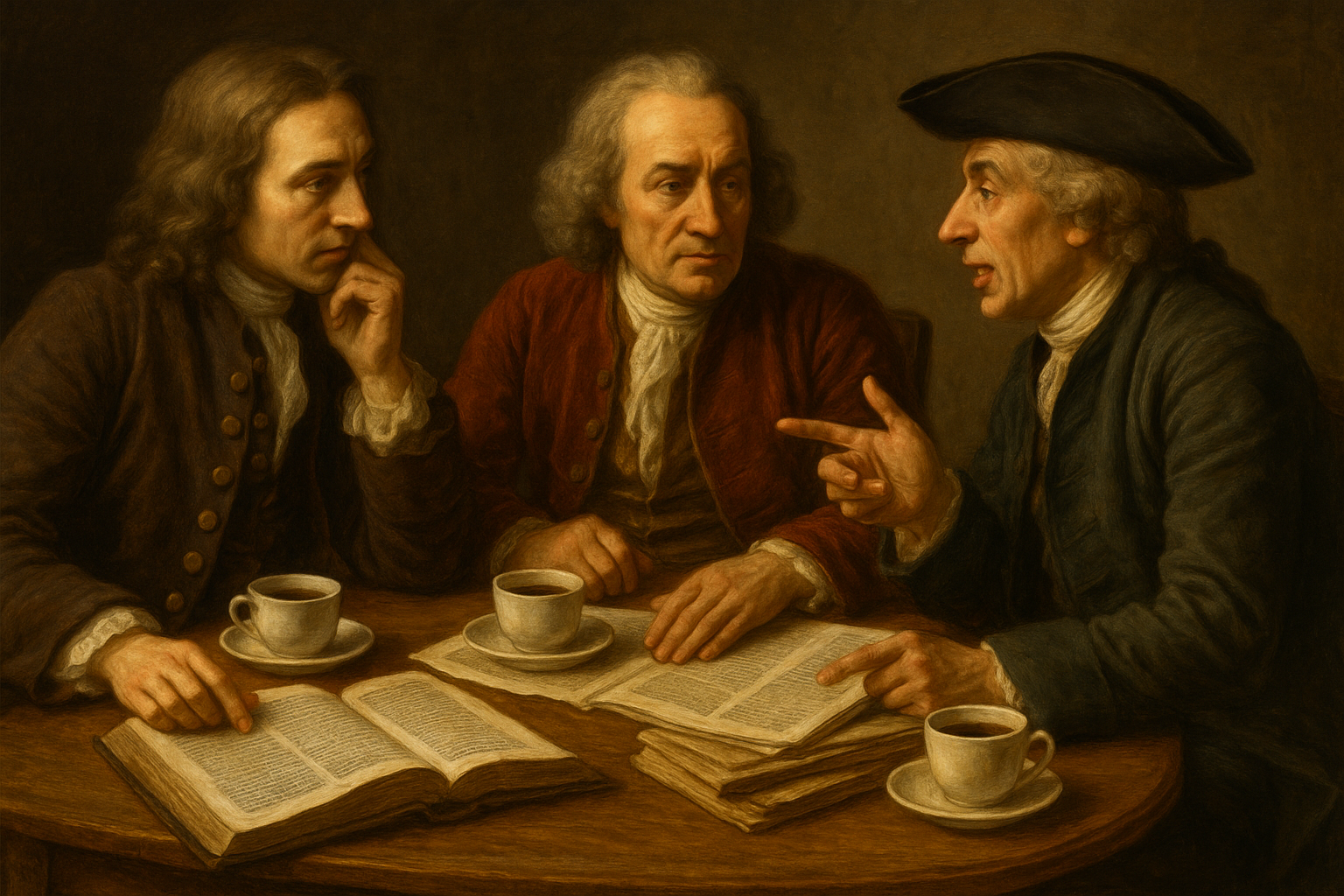
The 17th and 18th centuries brought profound change to Europe.
This was the Age of Enlightenment—a time of bold ideas, scientific discovery, and political revolution. At the heart of it all, often overlooked, sat a small cup of black liquid: coffee.
Coffeehouses became the unofficial headquarters of Enlightenment thinkers, where philosophers, scientists, writers, and revolutionaries gathered to discuss ideas that would reshape the modern world.
Coffee didn’t just wake people up. It sharpened their minds and stirred their spirits. It changed how people thought—and where they thought.
This article explores how coffee and the places where it was consumed became central to the rise of modern philosophy and democratic thought.
The Rise of the Coffeehouse
Before the Enlightenment, public discussion was limited.
Taverns and inns were noisy, chaotic places, and salons were reserved for the elite. There were few neutral spaces where people of different classes could come together to exchange ideas.
Enter the coffeehouse.
Imported from the Islamic world, coffeehouses began to appear in London, Paris, Vienna, and Berlin in the late 1600s.
These spaces were calm, sober, and intellectual. People sat at tables for hours, drinking coffee and engaging in long discussions about science, religion, art, and politics.
Coffeehouses quickly earned the nickname “penny universities”—for the cost of a cup, one could join in conversations with scholars, merchants, and philosophers.
Coffee vs. Alcohol: A Cognitive Revolution
In many ways, coffee replaced alcohol as the intellectual’s drink of choice.
For centuries, beer and wine were consumed even at breakfast. Water wasn’t always safe, and alcohol was often the default beverage.
But alcohol dulls the mind. Coffee does the opposite.
With the introduction of coffee, a new kind of mental clarity became possible. Writers could write longer. Scientists could study later. Debates could go deeper.
Coffee became a stimulant for thought, fueling long hours of reading, writing, and reflection.
Voltaire reportedly drank 40–50 cups of coffee a day while writing. He believed it helped power his mind through long sessions of philosophical work.
London’s Coffeehouse Enlightenment
In London, coffeehouses became hotbeds of intellectual and political debate.
Isaac Newton, John Locke, and Samuel Pepys all frequented them. Newspapers were read aloud, letters were shared, and new scientific theories were argued over steaming mugs.
Different coffeehouses attracted different crowds:
- Scientists gathered at Garraway’s
- Poets and writers at Will’s Coffee House
- Merchants and economists at Lloyd’s, which later became Lloyd’s of London
Each venue became a kind of microcosm of public life—open, opinionated, and fiercely engaged.
It was in these spaces that many of the ideas that shaped the British Enlightenment were born.
Parisian Cafés and Revolutionary Thinking
In France, coffee became the drink of the philosophes—the intellectuals who challenged monarchy, church authority, and traditional power structures.
Cafés in Paris, like Café Procope, welcomed thinkers such as Voltaire, Rousseau, Diderot, and later, Robespierre and Marat.
These were not casual gatherings. They were incubators of revolution.
Enlightenment thinkers debated the social contract, freedom of speech, religious tolerance, and human rights—concepts that would fuel the French Revolution and influence political systems worldwide.
In these cafés, ideas flowed as freely as the coffee. And those ideas changed history.
Coffee and the Spread of Printed Knowledge
Coffeehouses weren’t just for conversation. They were also places of information exchange.
Because newspapers and journals were expensive, many were kept at coffeehouses for communal reading. Some coffeehouses even subscribed to foreign papers, giving patrons access to international news and perspectives.
This helped spread Enlightenment ideas quickly and widely.
In fact, the coffeehouse became one of the first examples of a democratized media space—where access to information was open, not restricted to the elite.
Literacy rose. Political awareness spread. A more informed, engaged public began to emerge.
And coffee fueled it all.
The German Coffeehouse and Rational Idealism
In Germany, Enlightenment thought took a slightly different path, focusing on reason, logic, and ethics.
Philosophers like Immanuel Kant and Gotthold Ephraim Lessing were deeply engaged in discussions about morality, duty, and the nature of human understanding.
While Kant himself was famously routine-bound and did not often socialize, the broader intellectual community in Leipzig, Berlin, and Weimar used coffeehouses as places for scholarly exchange.
Journals and books were shared, ideas were debated, and coffee played a role in creating what Germans called the Bildungsbürger—the educated, culturally refined citizen.
The Coffeehouse as a Democratic Space
What made the Enlightenment coffeehouse unique was its open-door policy.
Unlike royal courts or university halls, coffeehouses welcomed a diverse range of people—students, shopkeepers, clergy, lawyers, and artists.
This was radical.
For the first time, men (and in some places, women) could sit side-by-side, regardless of status, and challenge one another’s views.
Debate became a social ritual. Agreement wasn’t required—but participation was encouraged.
This culture of public discourse laid the groundwork for modern democracy, free speech, and civil society.
Criticism and Controversy
Not everyone loved the rise of the coffeehouse.
Some rulers and religious authorities saw them as dangerous.
In several countries, coffeehouses were periodically banned or censored because they were viewed as centers of sedition and rebellion.
Authorities feared what happened when citizens gathered to question power.
But this only fueled their popularity. The more coffee was banned, the more it became a symbol of freedom and critical thinking.
It was more than a drink—it was an act of defiance.
Coffee and Enlightenment Literature
Coffee also left its mark on Enlightenment literature.
Writers like Jonathan Swift and Alexander Pope referenced coffee in their poems and essays. In The Rape of the Lock, Pope describes coffee as “the grave counsel and majestic talk.”
Diderot and Montesquieu used café settings in their satirical works, reflecting the blend of real debate and literary performance found in Enlightenment coffeehouses.
Coffee became a metaphor for clarity, vision, and mental stimulation.
It wasn’t just what people drank—it was what powered the ideas they expressed.
The Global Impact of Coffee-Fueled Ideas
The political systems we live under today were shaped by Enlightenment thought—and, indirectly, by coffee.
Concepts like:
- Separation of powers
- Freedom of the press
- Individual rights
- Secular governance
- Social contracts
…were all refined in coffeehouses.
These ideas influenced the American Revolution, the French Revolution, and countless other movements for liberty and reform across the globe.
Coffee helped accelerate the information age of the 18th century, long before the internet or electricity.
Enlightenment Women and the Salon-Café Connection
Although many early coffeehouses were male-dominated, women found their intellectual space in salons—private gatherings hosted in homes.
But the café-salon line eventually blurred.
In cities like Paris and Berlin, women became more active in public debates, sometimes hosting mixed-gender literary cafés or participating in discussions at the fringes of male-dominated spaces.
Women like Madame Geoffrin and Emilie du Châtelet (a physicist and Voltaire’s collaborator) played significant roles in Enlightenment thought, often over coffee and conversation.
Final Thoughts: Brewing Change, One Cup at a Time
The Enlightenment changed the world—and coffee was there for every page, every paragraph, and every protest.
It stimulated minds, inspired revolutions, and created new models for how people could gather and share ideas.
Today, as we sit in cafés with laptops or notebooks, debating the future or reading about the past, we’re continuing a tradition that began centuries ago.
Coffee is more than a beverage. It’s a cultural force, a symbol of freedom, and a catalyst for thinking.
And in every cup, there’s a little bit of Enlightenment.

Marcelo Oliveira is a passionate coffee enthusiast and writer who explores every angle of the world’s favorite brew—from its rich history to modern brewing techniques. With a deep appreciation for both tradition and innovation, Marcelo brings clear, engaging insights to help readers enjoy coffee on a whole new level.