
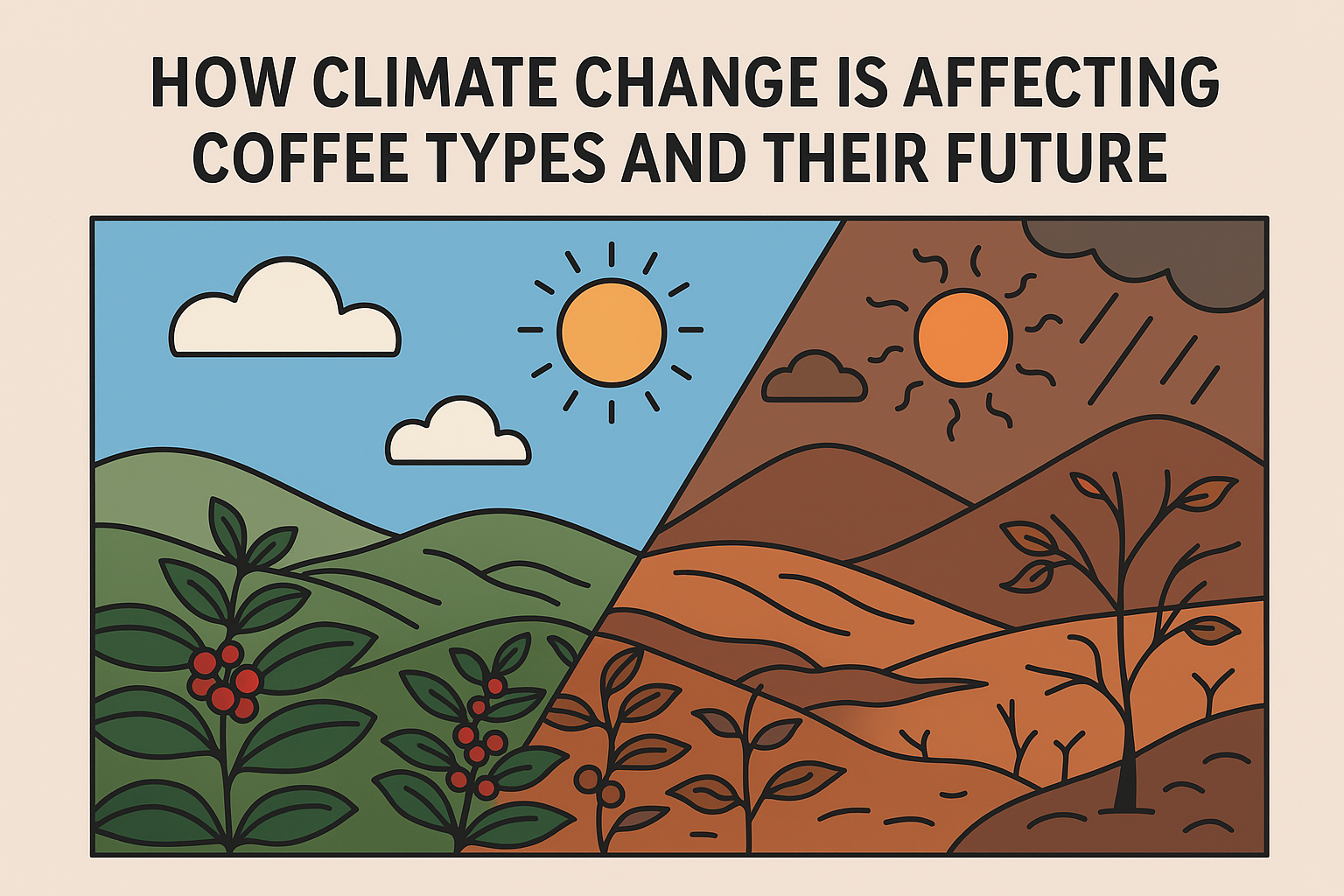
Coffee is more than just a morning ritual—it’s a global commodity, a livelihood for millions, and a complex agricultural product that depends heavily on specific environmental conditions.
But those conditions are changing.
As global temperatures rise and weather patterns shift, the world’s coffee producers are facing new and escalating challenges. The question is no longer if climate change will impact coffee, but how much, how fast, and what can be done to adapt.
In this article, we’ll explore how climate change is affecting coffee types, the regions where they grow, and what the future of coffee might look like in the coming decades.
Why Coffee Is So Sensitive to Climate
Coffee, especially Arabica, is incredibly sensitive to its environment. It thrives in a narrow range of conditions, often called the coffee sweet spot.
Ideal growing conditions include:
- Temperatures between 18°C and 22°C (64°F–72°F)
- High altitudes (1,000m–2,200m)
- Predictable rainy and dry seasons
- Consistent sunlight and shade
- Stable ecosystems
Even small disruptions—like too much rain, irregular temperatures, or longer droughts—can have major impacts on plant health, bean quality, and crop yields.
The Main Threats Climate Change Poses to Coffee
Let’s break down the key ways climate change is already affecting coffee production around the world.
1. Rising Temperatures
As global average temperatures increase, lower-altitude regions that were once ideal for coffee are becoming too hot.
This leads to:
- Faster cherry ripening, reducing flavor development
- Increased pest activity (like the coffee borer beetle)
- Lower yields
- Decline in bean density and quality
In some regions, farmers are being forced to move their farms higher into the mountains—a strategy with limits, especially in countries with limited land or elevation.
2. Unpredictable Rainfall Patterns
Coffee plants rely on a clear rhythm of wet and dry seasons. These cycles control flowering, fruit development, and harvest timing.
Climate change is disrupting this rhythm, causing:
- Delayed or erratic flowering
- Longer or heavier rainy seasons
- Increased risk of fungal diseases like coffee leaf rust (la roya)
- Harvest losses due to floods or landslides
Farmers are finding it harder to plan or predict, which increases risk and reduces income stability.
3. More Pests and Diseases
Warmer climates favor the spread of coffee pests and diseases.
Examples include:
- Coffee berry borer: A beetle that destroys the bean from the inside
- Leaf rust fungus: Causes defoliation and loss of productivity
- Root-knot nematodes: Parasitic worms that damage root systems
These threats are expanding into new regions where they previously didn’t exist—catching farmers off guard.
4. Loss of Suitable Growing Land
By 2050, it’s estimated that up to 50% of current coffee-growing land may become unsuitable for traditional Arabica cultivation.
Some regions may disappear entirely from the coffee map, while others—like parts of East Africa or highlands in Asia—may become new hubs.
But expansion into new land comes with its own issues, including deforestation, loss of biodiversity, and conflict with local ecosystems.
How Different Coffee Types Are Being Affected
Not all coffee is impacted equally. Here’s how different types are responding to climate change.
Arabica (Coffea arabica)
- Most popular in specialty coffee
- Grown at high altitudes
- Highly sensitive to temperature and rainfall changes
- Vulnerable to disease
Arabica is already in decline in some traditional regions like Brazil’s lower elevations and Central America’s mid-altitudes.
Robusta (Coffea canephora)
- More tolerant of heat and disease
- Grown at lower altitudes
- Used in instant coffee and commercial blends
Robusta is becoming more important as a climate-resilient alternative, especially for farmers in warmer areas.
However, its flavor is less complex, which makes it less desirable for specialty markets.
New Hybrids and Varietals
In response, scientists and agronomists are developing hybrids that combine flavor, productivity, and resilience.
Examples include:
- Catimor: Rust-resistant, higher yield
- Ruiru 11: Popular in Kenya, resistant to major diseases
- SL28 (Kenya): High-quality flavor, but less resistant
- F1 hybrids: Next-generation coffees bred for adaptability and cup quality
These new types may play a key role in the future of coffee farming.
Countries and Regions on the Front Lines
Some producing countries are more vulnerable than others.
Brazil
- Largest coffee producer in the world
- Facing erratic droughts and frost events
- Arabica production moving to higher altitudes
Brazil’s size gives it flexibility, but it’s not immune to extreme weather.
Ethiopia
- Birthplace of Arabica
- High-altitude terrain offers protection
- Threatened by deforestation and temperature shifts
Many heirloom varieties may be lost without conservation efforts.
Colombia
- Known for balanced Arabica coffees
- Increasing rainfall and landslides disrupt harvests
- Farmers adapting with hybrids and shade systems
Colombia remains a leader in climate-smart coffee development.
Vietnam
- Largest Robusta producer
- Lower elevations face rising temperatures
- Water scarcity is a growing issue
Vietnam is investing in irrigation and drought-resistant farming.
How Farmers Are Adapting
Many farmers are taking steps to future-proof their crops.
1. Moving to Higher Elevations
Some producers are relocating their farms to cooler climates—when possible.
But this isn’t always feasible due to land access, costs, or environmental regulations.
2. Planting Shade Trees
Shade-grown coffee helps:
- Reduce heat stress
- Conserve soil moisture
- Provide biodiversity and natural pest control
Agroforestry is one of the most promising climate-adaptive strategies.
3. Using Resistant Varieties
Switching to rust-resistant or drought-tolerant coffee varieties gives farmers more security.
Some of these newer varieties offer both high yields and acceptable cup quality, though not all match traditional flavor expectations.
4. Experimenting with New Processes
Some producers are altering fermentation or drying processes to preserve quality despite lower bean density or changing harvest cycles.
This includes anaerobic fermentation, carbonic maceration, or mechanical drying when sun isn’t available.
5. Improving Soil and Water Management
Farmers are investing in:
- Mulching
- Composting
- Irrigation systems
- Water-saving technologies
These efforts help coffee trees survive in increasingly hostile environments.
What the Coffee Industry Is Doing
Larger players in the coffee supply chain are also responding.
1. Research and Development
Institutes like World Coffee Research and CIAT are working to:
- Develop new varietals
- Share climate adaptation data
- Support breeding and genetics in vulnerable countries
2. Sustainability Certifications
Programs like:
- Rainforest Alliance
- Fair Trade
- Organic certifications
Encourage environmentally friendly farming practices, though they vary in climate-specific strategies.
3. Direct Trade and Investment
Roasters and importers are building long-term relationships with farmers, offering support in:
- Training
- Equipment upgrades
- Financial planning
This helps producers adapt while maintaining supply chains.
The Future of Coffee: What Can We Expect?
The next few decades will reshape how coffee is grown, sold, and consumed.
Here’s what may change:
- More Robusta in blends, even in specialty markets
- Flavor profile shifts, as new varieties become common
- Rising prices due to supply instability
- Emerging origins from places like Nepal, China, or the southern U.S.
- Tech-driven farming, including AI crop monitoring and climate modeling
At the same time, consumers may be asked to redefine what “good coffee” means, focusing not just on flavor, but on resilience and sustainability.
What You Can Do as a Coffee Drinker
Even small actions help shape the future of coffee. Here’s how:
- Buy from transparent roasters who source sustainably
- Support producers using agroforestry or climate-smart practices
- Try new coffee types, including hybrid varietals or Robusta blends
- Donate to coffee conservation projects
- Stay informed about how climate change affects your daily cup
Coffee’s survival isn’t guaranteed—but informed consumers make a difference.
Final Thoughts: A Fragile Future, but Not a Hopeless One
Coffee is at a crossroads. Climate change is testing its limits, challenging the way it’s grown and enjoyed.
But this story isn’t just about loss—it’s also about adaptation, innovation, and hope.
With global collaboration, scientific progress, and conscious consumer choices, the world can preserve and reinvent coffee for generations to come.
The next time you sip your brew, remember: it’s not just a beverage—it’s a global effort in every cup.

Marcelo Oliveira is a passionate coffee enthusiast and writer who explores every angle of the world’s favorite brew—from its rich history to modern brewing techniques. With a deep appreciation for both tradition and innovation, Marcelo brings clear, engaging insights to help readers enjoy coffee on a whole new level.