
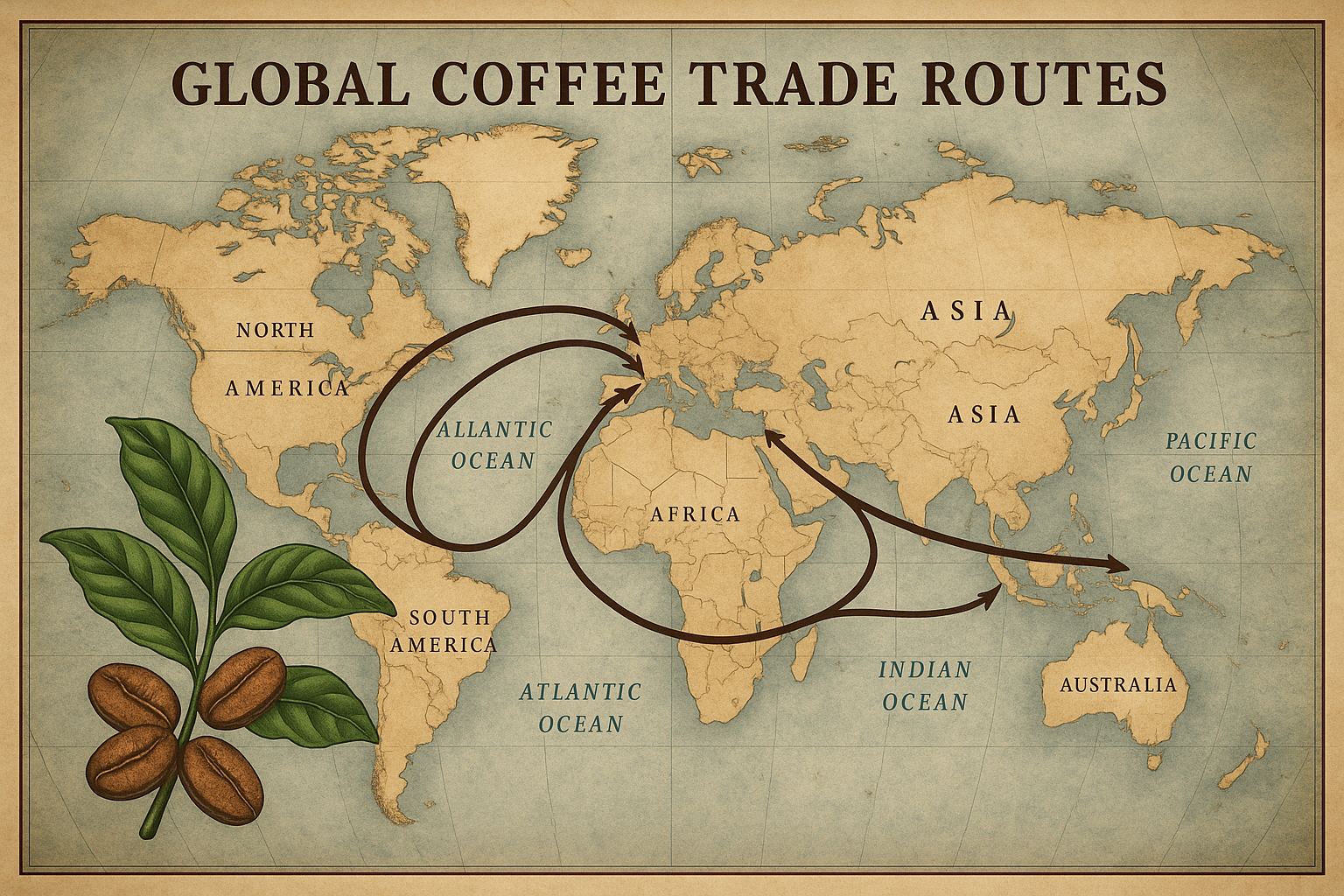
Coffee is a truly global beverage. Whether brewed in an Italian espresso bar, a Turkish cezve, or a modern drip machine, it connects cultures, economies, and people around the planet.
But how did it get there?
The journey of coffee from wild Ethiopian forests to nearly every country on Earth is a story of trade, empire, ambition, and transformation. Along its path, the bean crossed continents, built fortunes, started revolutions, and shaped international relationships.
This article explores the historic trade routes that spread coffee around the world—and how those routes helped define the modern global economy.
Origins in Ethiopia
The story of coffee begins in the highlands of Ethiopia, where the coffee plant (Coffea arabica) is native.
According to legend, a goatherd named Kaldi noticed his goats becoming energetic after eating red berries from a certain bush. Curious, he tried them himself—and experienced a new kind of wakefulness.
While this story is likely apocryphal, it reflects the powerful impact coffee had on early users.
From Ethiopia, coffee spread to Yemen, across the Red Sea, where it would become part of spiritual rituals and daily life.
Yemen and the Port of Mocha
In the 15th century, Yemen became the first region to cultivate and commercialize coffee.
Sufi monks drank coffee to stay alert during nighttime prayers, and the beverage quickly spread through religious circles.
The port city of Mocha (or al-Makha) became the first major hub for coffee export.
From Mocha, coffee was shipped throughout the Islamic world—to Egypt, Persia, Turkey, and beyond. The name “Mocha” would later be used globally to describe both a flavor and a type of coffee bean.
Yemen tightly controlled coffee cultivation, forbidding the export of fertile seeds. But this would not last forever.
The Ottoman Empire and Coffee’s Expansion
The Ottoman Empire played a key role in spreading coffee across the Middle East, North Africa, and Eastern Europe.
By the mid-1500s, coffeehouses—called qahveh khaneh—were flourishing in cities like Istanbul, Cairo, and Damascus.
Merchants, artists, poets, and scholars gathered to drink coffee and exchange ideas.
Ottoman trade routes helped carry coffee throughout the empire, linking caravans to shipping lanes and introducing the drink to European visitors and diplomats.
Coffee became a cultural institution—and a political force—in every region it touched.
Coffee Reaches Europe: Venice, Amsterdam, and London
European traders first encountered coffee in the 16th and 17th centuries.
Venetian merchants brought coffee from the Ottoman Empire to Italy, where it gained popularity among aristocrats and intellectuals.
From there, the bean traveled to Amsterdam, where Dutch traders helped spread it through their powerful shipping networks.
The Dutch East India Company played a crucial role in expanding coffee beyond the Islamic world.
In London, the first coffeehouse opened in 1652. It quickly became a favorite of merchants and thinkers, laying the groundwork for Britain’s own coffee obsession.
These cities became nodes in a growing global trade network.
Smuggling Coffee Plants: The Dutch and the French
Coffee remained an Eastern secret until European powers began smuggling plants and seeds.
In the late 1600s, the Dutch successfully transplanted coffee trees to Java in modern-day Indonesia. This marked the beginning of European colonial coffee cultivation.
By the 18th century, the French, Portuguese, and Spanish had all established coffee plantations in their colonies, often using enslaved labor.
Coffee now had global roots—from the Americas to Asia.
The trade routes expanded accordingly, with ships transporting beans from Caribbean plantations, Brazil, Ceylon, and Java to Europe and North America.
The Caribbean and Central America
In the 18th and 19th centuries, coffee production exploded in the Caribbean and Central America.
Haiti, then a French colony, became one of the world’s leading exporters of coffee—until the Haitian Revolution disrupted trade.
Later, countries like Guatemala, El Salvador, and Costa Rica emerged as major producers.
Trade routes shifted again, as ports like Puerto Barrios, San Salvador, and Cartagena became central to exporting beans to the U.S. and Europe.
Coffee was now a key player in colonial economies, shaping both political power and trade strategy.
Brazil: The Coffee Superpower
Brazil became the world’s largest coffee exporter by the mid-1800s—and still holds that title today.
Its vast plantations, centered in São Paulo and Minas Gerais, were connected by railroads and shipping lines built specifically to support coffee exports.
Coffee from Brazil traveled through Santos, the main port city, to destinations around the world.
The sheer scale of Brazil’s production changed the global market. Prices fluctuated based on Brazilian harvests, and the country’s influence shaped international coffee trade policies.
Global demand kept growing, and Brazil’s coffee reached every corner of the map.
Coffee and the Rise of the United States
In the 19th century, the United States became one of the largest consumers of coffee.
American merchants sourced beans from Latin America, Africa, and Asia, establishing powerful trade relationships.
Cities like New York, New Orleans, and San Francisco became major import hubs. Coffeehouses flourished, especially among intellectuals and business elites.
The U.S. Navy even helped secure trade routes, ensuring that coffee supply remained stable and under American influence.
By the 20th century, coffee had become a staple of American life—and a central part of its trade network.
The Role of Shipping and Transport
Without reliable transportation, the global coffee trade could not exist.
From camel caravans crossing the Arabian deserts to clipper ships crossing the Atlantic, every link in the supply chain mattered.
Steamships and railroads revolutionized delivery, shortening the time from harvest to cup.
Later, containerized shipping and air freight enabled even faster movement of green coffee beans to roasters around the world.
Each innovation made coffee more accessible, cheaper, and more consistent.
The journey of the bean had become an industrial marvel.
Global Coffee Hubs and Trading Markets
Today, major trading hubs keep the coffee economy moving.
New York and London host major commodity exchanges where coffee futures are bought and sold.
Hamburg, Antwerp, and Trieste are key European ports for coffee storage and distribution.
In Asia, Singapore and Tokyo handle large volumes of coffee shipments to meet rising demand.
Behind every cup of coffee is a global network of farmers, exporters, importers, roasters, and retailers. And all of them rely on complex trade routes.
Ethical Trade and Modern Challenges
The history of coffee trade isn’t without dark chapters.
Colonial exploitation, slave labor, and economic dependence shaped much of the global supply chain.
Today, there’s growing awareness of these issues. Movements like Fair Trade, Direct Trade, and Sustainable Coffee aim to create more ethical and equitable systems.
But challenges remain.
Climate change, price volatility, and labor rights continue to threaten the future of coffee production and trade.
Understanding the history of trade routes helps us see where improvements are still needed.
Coffee’s Cultural Journey Along the Trade Routes
As coffee traveled, it took on new cultural meanings.
In Italy, it became espresso.
In Sweden, it inspired the “fika” break.
In Ethiopia, it remains sacred and ceremonial.
Every stop along the trade route added something unique—new brewing methods, customs, and rituals. Today’s global coffee culture is a mosaic shaped by centuries of movement and exchange.
Coffee is both local and global, intimate and international.
Its trade routes carried more than beans—they carried culture.
Final Thoughts: A Journey Still in Motion
The journey of coffee across the world is one of the greatest logistical and cultural achievements in human history.
What began in the Ethiopian highlands is now a daily ritual for billions of people.
From camel caravans to cargo ships, from smuggled seeds to industrial plantations, coffee has traveled further than almost any other product.
And it continues to evolve.
As we face global challenges, from sustainability to equity, the coffee trade must adapt. But one thing is certain: the journey of the bean is far from over.
Every cup is a sip of history, trade, and transformation.

Marcelo Oliveira is a passionate coffee enthusiast and writer who explores every angle of the world’s favorite brew—from its rich history to modern brewing techniques. With a deep appreciation for both tradition and innovation, Marcelo brings clear, engaging insights to help readers enjoy coffee on a whole new level.